

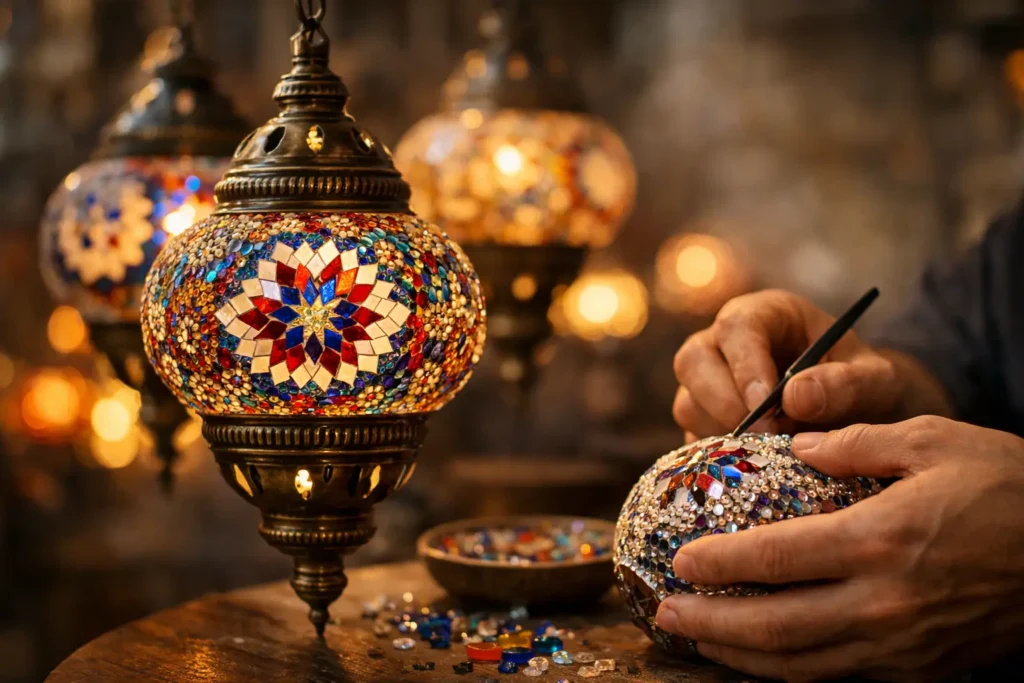
A Turkish mosaic lamp can change the feeling of a room the moment it is switched on. Its jeweled glass casts warm color across a wall, its metalwork brings texture to a quiet corner, and no two handmade patterns look exactly alike. So, why are Turkish lamps expensive compared with many factory-made lamps? The answer is found in the patient work, specialized materials, and artistic character built into every glowing piece.
For shoppers who want more than a basic light source, that difference matters. A well-made Turkish lamp is part lighting, part decorative art, and part heirloom-style accent. Its price reflects the hands, time, and detail behind the finished glow.
Why Are Turkish Lamps Expensive to Make?
The most significant cost is craftsmanship. Traditional Turkish mosaic lamps are assembled piece by piece, often using small cuts of colored glass, glass beads, and carefully arranged geometric or floral motifs. Rather than printing a design onto a manufactured shade, an artisan creates the pattern by hand.
That process is wonderfully detailed. First, the globe shape is prepared. Tiny pieces of glass are selected by color, cut to fit, and placed into a deliberate design. The spaces between them are filled with a plaster-like mosaic medium that secures the surface and gives the pattern its distinctive texture. Once the work has set, the globe is cleaned, finished, and fitted to its lamp base or chandelier frame.
A single globe may contain hundreds of individual pieces. A chandelier with several globes multiplies the labor considerably. Even when artisans follow a familiar pattern, the placement of glass, the balance of color, and the final texture are never completely identical. That small variation is not a flaw. It is the signature of handmade décor.
Mass-market lighting is built for speed and repetition. Components are molded, printed, and assembled by machines in high volume. Turkish mosaic lighting follows a different rhythm. It asks for skilled hands and time, two things that cannot be rushed without losing the artistry buyers love.
Hand-cut glass creates the color story
The brilliant color is another reason these lamps command attention and price. Deep cobalt blue, ruby red, amber, emerald, turquoise, and ivory glass must work together whether the lamp is lit or resting quietly in daylight. A beautiful globe is not simply colorful. It has balance.
Artisans choose pieces that create contrast, depth, and a pleasing rhythm around a curved surface. When illuminated, those tiny glass pieces become the lamp’s personality. This is why a mosaic lamp can feel rich and layered in a way a plain fabric or plastic shade rarely does.
The quality of the glass also affects the final result. Better materials hold their color, reflect light beautifully, and create a more luminous finish. Less expensive imitations may use thin plastic-like pieces, painted surfaces, or simplified patterns that look attractive from a distance but lack the sparkle and dimension of genuine mosaic work.
The Metalwork Is More Than a Frame
A Turkish lamp’s brass-toned or antique-finished metal components do essential visual and structural work. The base, stem, cap, chains, ceiling plate, and globe holders must support the piece securely while complementing the hand-laid mosaic surface.
In a table lamp or floor lamp, a stable base is especially important. In a hanging chandelier, the frame must hold multiple glass globes at the correct spacing and height. More elaborate designs require more components, more assembly, and more careful inspection before they are ready for a home.
Metalwork also determines whether a lamp feels like a decorative object when it is off. Thoughtful detailing gives a piece that old-world Turkish character: ornamental silhouettes, warm finishes, and proportions that make the lamp feel collected rather than ordinary. A simple one-globe lamp naturally uses fewer materials and less labor than a multi-globe chandelier, which is why size and configuration can dramatically change the price.
Design Complexity Changes the Cost
Not every Turkish lamp takes the same amount of time to create. A small bedside lamp with one globe and a classic star motif is a relatively straightforward piece. A large floor lamp, wall sconce pair, or chandelier with five, seven, or eleven globes is a much more involved production.
Complexity can come from the number of globes, the intricacy of the mosaic pattern, the metal framework, or the desired color combination. A design with precise borders, layered floral forms, or many contrasting shades requires closer attention than a broad, repeating pattern.
Customization adds another layer of value. Selecting globe colors to complement a dining room, entryway, bedroom, or boutique space means the piece is made to suit a particular vision rather than pulled from a one-color, one-size warehouse shelf. For many décor lovers, that ability to dream, design, and decorate with intention is worth the additional investment.
Importing and Safe Delivery Are Part of the Price
Turkish lamps travel a long way before they light up a home in the United States or Canada. Because they combine glass, metal, and delicate handcrafted surfaces, they need protective packing and careful handling. Larger chandeliers may also include multiple fragile globes, chains, fittings, and assembly components.
International transportation, customs processes, protective packaging, domestic warehousing, and final delivery all add real cost. This is particularly true for oversized statement lighting. A large chandelier may be visually airy, but its shipment still requires planning to protect every globe from damage.
Buying from a retailer that imports directly can help keep pricing more accessible than passing a piece through several distributors. Still, direct import pricing does not erase the realities of handmade production, fragile materials, and careful shipping. It simply helps bring more of the value closer to the customer.
What You Are Paying For – and What You Are Not
An expensive Turkish lamp is not automatically a better Turkish lamp. Price should make sense in relation to craftsmanship, materials, size, construction, and the seller’s care. A handmade piece may carry small differences in glass placement or metal finish, but it should still feel secure, thoughtfully assembled, and visually balanced.
When comparing options, look beyond the product photo. Consider whether the globe is true hand-laid mosaic or a printed imitation, whether the lamp has a sturdy base or frame, and whether the electrical components are appropriate for your home. Also consider the scale. A petite table lamp can bring color to a nightstand, while a multi-globe chandelier becomes the focal point of an entire room.
A lower price can be a good value when the design is simpler, the piece is smaller, or the seller works directly with makers. It becomes less compelling when it signals lightweight materials, flat printed patterns, unreliable assembly, or poor packing. The best choice depends on where the lamp will live and how much visual impact you want it to create.
A statement piece can earn its place
A Turkish lamp is often compared to ordinary lighting because it has a bulb and a cord. But that comparison misses what makes it special. This is décor that creates atmosphere even before the light comes on. It can soften a reading nook, bring drama to an entryway, make a guest room feel more personal, or add memorable warmth to a restaurant or boutique setting.
For a room with neutral furniture, a mosaic lamp can introduce color without committing to a painted wall or permanent renovation. For a richly layered interior, it can echo textiles, art, ceramics, and collected treasures. Its flexibility is part of its appeal: the same traditional craft can feel bohemian, Mediterranean, maximalist, eclectic, or elegantly classic depending on the space around it.
At Whispers of Istanbul, the joy is in choosing a piece that feels made for your home, whether that means a serene blue globe for a bedroom or a vivid multicolor chandelier for the dining room. The right lamp does more than fill a corner. It gives the room a glow, a story, and a statement in style.
