

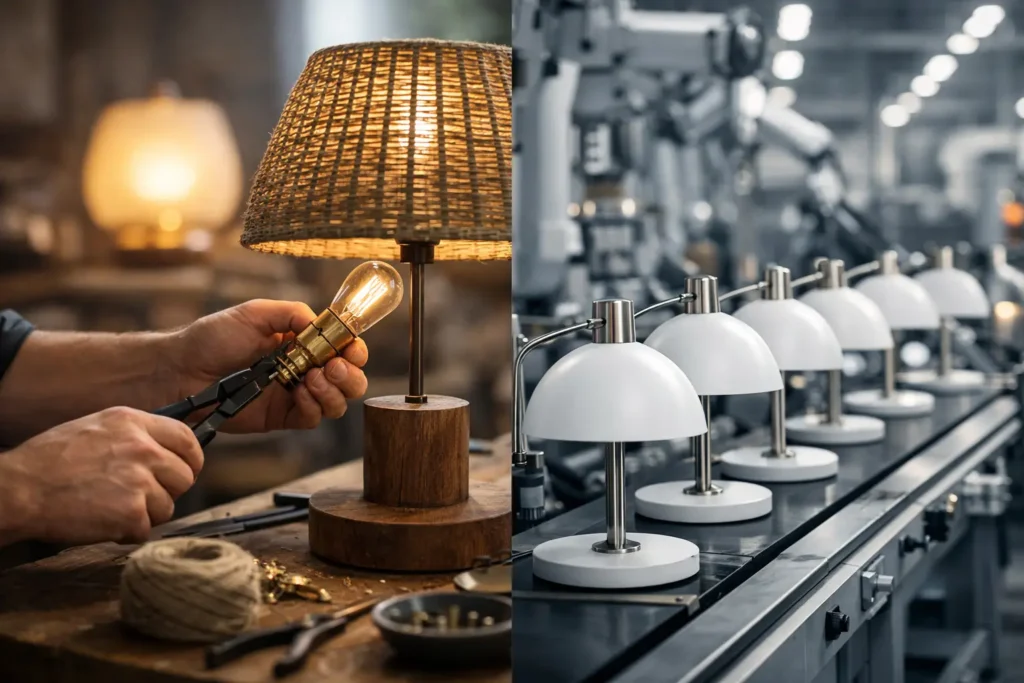
One lamp fades into the room. Another changes it completely. That is usually the real difference in handmade lamps versus factory lamps – not simply how they look on a shelf, but how they feel once they are switched on in your home.
If you are choosing lighting for a living room, entryway, bedroom, dining area, or boutique-style space, the decision is about more than price. It is about character, atmosphere, longevity, and whether the piece feels like part of your story or just another household item. For design lovers who want lighting to make a statement in style, this comparison matters.
Handmade lamps versus factory lamps: what sets them apart
At a glance, both types of lamps may serve the same purpose. They light a room. They complete a table, corner, or ceiling line. But the way they are made creates a very different result.
A handmade lamp carries the mark of a human hand. You see it in the cut of the glass, the setting of the mosaic pieces, the shaping of the metal, and the subtle variations that make the finished work feel alive. In Turkish mosaic lighting especially, those details are the magic. The pattern is not printed to imitate artistry. It is built piece by piece, often with remarkable patience and care.
A factory lamp is designed for speed and sameness. That is not automatically bad. Mass production can create clean, practical lighting at a lower cost. If the goal is to furnish a rental quickly or fill a temporary space with basic function, factory-made options can make sense. But when every lamp is nearly identical, the visual experience tends to be flatter and less memorable.
The difference you can actually see
The first thing most shoppers notice is depth. Handmade lamps often have a richness that factory pieces struggle to replicate. The colors tend to feel more layered. The surfaces catch light with more variation. The pattern has dimension instead of a repeated, machine-perfect uniformity that can sometimes feel cold.
This is especially true with handcrafted mosaic globes and decorative chandeliers. When colored glass is arranged by hand, the lamp becomes expressive both when lit and unlit. During the day, it reads like art. In the evening, it casts warmth, color, and movement across the room. That kind of visual drama is difficult to mass manufacture convincingly.
Factory lamps often lean on trend cycles. One year it is matte black minimalism, the next it is generic brass, then oversized industrial silhouettes. Handmade lighting tends to sit outside that rhythm. It can feel timeless because it is rooted in craft rather than in fast retail fashion.
Craftsmanship affects quality
A lamp is decorative, but it is also an object you live with. You turn it on daily. You dust it. You place it where people gather. Quality matters.
With handmade lighting, craftsmanship is not a marketing extra. It is the product. The maker is involved in construction, alignment, finishing, and often in the decorative assembly itself. That usually creates stronger attention to detail. Glass pieces are set with care. Metalwork has more presence. The whole lamp feels considered.
Factory lamps can vary widely in quality. Some are decent for the price, while others look good in photos and disappoint in person. Thin materials, lightweight bases, synthetic-looking finishes, and short-lived detailing are common complaints in mass-market lighting. The issue is not that every factory lamp is poorly made. It is that production efficiency often comes before artistry.
For shoppers who want a lamp that feels substantial and special, handmade pieces usually offer more satisfaction over time.
Why imperfections can be a luxury
In handmade décor, slight variation is often a sign of authenticity. A tiny difference in glass placement or pattern symmetry is not a defect in the way many shoppers imagine. It is proof that the lamp was created, not stamped out.
That distinction matters in a world full of imitation finishes and machine-made copies trying to look artisanal. True handmade pieces have individuality. No two are quite the same, and that uniqueness is part of their value.
Style, personality, and emotional impact
Lighting shapes mood faster than almost any other décor element. A rug anchors a room. A sofa fills it. A lamp gives it atmosphere.
This is where handmade lighting often wins decisively. It brings personality into a space in a way factory lighting rarely does. A handcrafted Turkish mosaic table lamp can warm a reading nook instantly. A colorful chandelier can turn a dining room into a conversation piece. A hand-finished wall sconce can make a hallway feel curated rather than overlooked.
Factory lamps are often designed to be safe. They blend. They coordinate. They do not ask much of the room. That works for some interiors, especially if the goal is subtle background lighting. But if you want a home to feel layered, expressive, and a little unforgettable, handmade lamps offer more emotional range.
This is also why they make exceptional gifts. A factory lamp may be useful. A handmade lamp feels personal.
Handmade lamps versus factory lamps on customization
Customization is one of the clearest advantages of handmade lighting. With many artisanal pieces, especially mosaic chandeliers and globe lamps, you may be able to choose colors, globe arrangements, sizes, or configurations that fit your exact space and taste.
That changes the buying experience completely. Instead of trying to make your room work around a standard product, you can select a piece that reflects your vision. Soft blues and whites for a calm bedroom. Jewel tones for a dramatic dining room. Multicolor globes for an eclectic living area. A larger chandelier for a tall foyer. A smaller pendant grouping for a breakfast nook.
Factory lamps are usually limited to preset options. What you see is what you get. There may be a few finish choices, but true personalization is rare because it slows production. For shoppers who care deeply about design, that can feel restrictive.
At Whispers of Istanbul, this kind of customization is part of the charm. It allows statement lighting to feel even more personal, which is exactly what many homeowners and décor lovers are searching for.
What about price and value?
This is where the conversation becomes more nuanced. Factory lamps usually have the lower entry price. If you need several fixtures at once and budget is the only deciding factor, mass-produced lighting may seem like the easier path.
But value is not the same as low cost.
A handmade lamp often costs more because it contains more labor, more detail, and more artistry. You are paying for skilled work, not only raw materials. In many cases, you are also getting a design statement, a decorative object, and a source of ambient light all in one piece.
The better question is not Which is cheaper? It is Which gives more back to the room? A factory lamp may solve a functional need. A handmade lamp can elevate the entire setting and keep doing so for years.
For many buyers, that makes handmade lighting the better value, especially when it is sourced through direct-import pricing rather than inflated luxury retail markups.
When factory lamps do make sense
There are situations where factory lighting is perfectly reasonable. Utility spaces like laundry rooms, basic office corners, or temporary apartments may not require artisanal detail. If the lamp is meant to disappear into the background, mass-market options can do the job.
Factory lamps also suit shoppers who prefer a very minimal aesthetic and want lighting to stay visually quiet. Even then, quality should still be considered carefully, because low cost can quickly turn into short lifespan.
So this is not a question of one category being universally right and the other universally wrong. It depends on the room, the purpose, and how much meaning you want your lighting to carry.
Which one is right for your home?
If you want your home to feel distinctive, warm, and richly styled, handmade lighting usually offers something factory lamps cannot – soul. It brings heritage, craftsmanship, and visual texture into daily life. It gives guests something to notice and gives you something to enjoy every single evening.
If your priority is purely practical illumination at the lowest possible upfront cost, factory lighting may be enough. But enough is not always what makes a space memorable.
The most beautiful rooms rarely come from choosing only what is convenient. They come from selecting pieces with presence. Pieces with story. Pieces that leave a lasting impression the moment the light comes on.
So when you are deciding between handmade and factory-made lighting, look beyond the bulb and the base. Ask which lamp simply fills a space, and which one has the power to transform it. That answer usually makes the choice much easier.
