

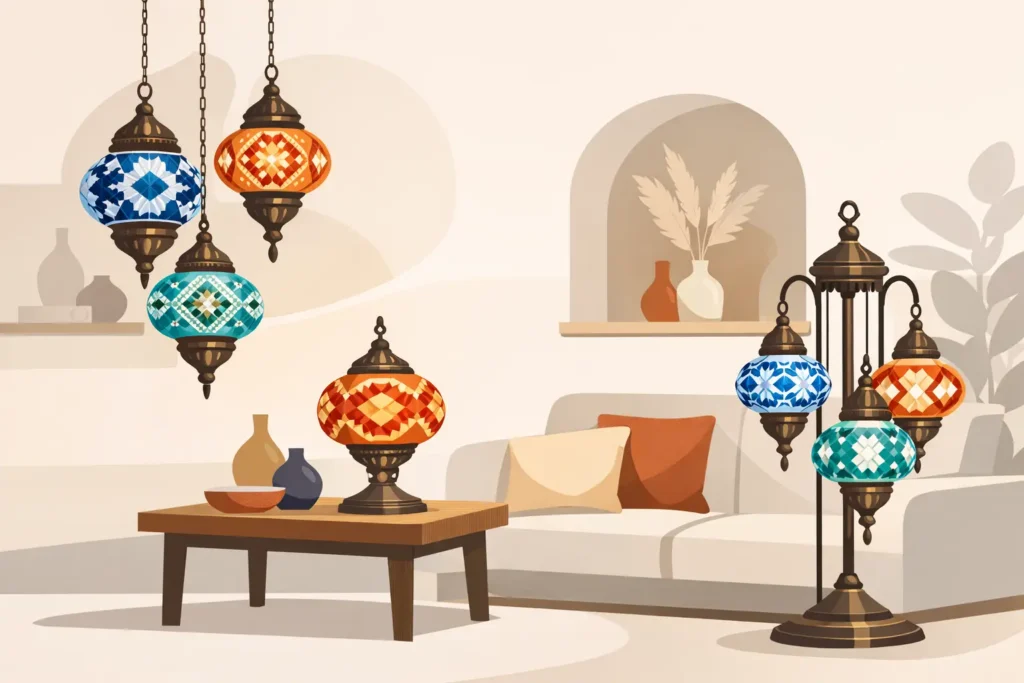
A Turkish lamp should never feel like an afterthought. The moment you place one in a room, it changes the mood, catches the eye, and brings in a layer of handcrafted beauty that ordinary lighting simply cannot match. If you are wondering how to style Turkish lamps in a way that feels elevated rather than overly themed, the answer starts with balance – let the lamp be expressive, then build the room around its color, glow, and artistry.
How to style Turkish lamps without overpowering a room
The biggest misconception is that Turkish mosaic lighting only works in highly ornate spaces. In reality, these pieces are remarkably versatile. A richly patterned globe can look just as striking in a modern condo as it does in a traditional home, provided the surrounding décor gives it room to shine.
Start by treating the lamp as either a focal point or a supporting accent. If you are styling a large mosaic chandelier over a dining table or in a two-story entryway, let it lead. Keep nearby finishes cohesive, and repeat one or two tones from the glass elsewhere in the room through pillows, ceramics, or art. If you are using a smaller table lamp or wall sconce, think of it as jewelry for the room. It does not need to match every detail. It only needs to feel intentional.
This is where scale matters. A petite mosaic lamp on an oversized console can disappear, while a dramatic floor lamp in a compact reading corner can feel immersive and beautiful. Before choosing placement, step back and look at the room’s visual weight. Turkish lamps bring pattern, texture, and color all at once, so they usually perform best when paired with simpler silhouettes nearby.
Use color to guide the entire space
When people ask how to style Turkish lamps, what they are really asking is how to make all that color feel refined. The easiest approach is to pull from the lamp itself. Mosaic glass often features jewel tones like sapphire blue, ruby red, amber, emerald, or multicolor combinations that shift beautifully when lit. Those tones can become your palette.
If your lamp features deep blues and whites, repeat those shades in a rug border, throw blanket, or decorative bowl. If you have warmer glass in amber and red, pair it with walnut wood, brass, and cream upholstery to keep the room warm and inviting. You do not need to mirror every shade exactly. In fact, a little restraint usually creates the most luxurious effect.
Neutral rooms benefit especially well from Turkish lighting. A soft beige bedroom, a white entryway, or a gray living room can come alive with one handcrafted lamp that introduces depth and personality. In this setting, the lamp becomes the piece that gives the room its point of view.
There is also a trade-off to consider. A multicolor lamp gives you flexibility and drama, but it asks for a lighter hand with other accessories. A single-color or more tonal mosaic design is easier to layer into an already decorated room. Neither is better – it depends on whether you want the lighting to dominate or complement.
Style by room, not by trend
Turkish lamps have timeless appeal, so it is better to style them according to the function and atmosphere of each room rather than chasing a passing trend.
Living room
In the living room, a Turkish floor lamp or table lamp works beautifully as ambient lighting. Place it beside a sofa, near an accent chair, or on a side table where the mosaic glow can soften the whole space by evening. This room is often the best place for bolder colors because it is where guests gather and where statement pieces naturally belong.
If your living room already has strong pattern in the rug or upholstery, choose a lamp with a more controlled color story. If the space feels plain, a vibrant mosaic lamp can do the heavy lifting. Pair it with textured materials like linen, velvet, wood, and antique-inspired metals for a layered look that feels collected rather than staged.
Bedroom
Bedrooms are ideal for Turkish bedside lamps, especially if you want light that feels romantic and restful. Here, softer palettes often work best – think blues, creams, soft greens, or warm amber. Matching lamps on both nightstands creates symmetry, while two coordinating but not identical lamps feel a bit more personal.
Keep the surrounding décor calm. Crisp bedding, upholstered headboards, and simple nightstands let the craftsmanship stand out. The lamp should feel like a quiet luxury, not visual noise.
Dining room
A Turkish chandelier over the dining table can completely transform the room. It brings intimacy, artistry, and a sense of occasion that standard overhead lighting rarely delivers. This is one place where customization can make a major difference. The right number of globes, the right drop length, and the right color mix can make the fixture feel perfectly tailored to your table and ceiling height.
In dining spaces, repeat the lamp’s presence through small details rather than more lighting. Ceramic accents, brass candleholders, or a richly toned runner can echo the handcrafted spirit without competing with it.
Entryway
If you want a first impression that leaves guests spellbound, the entryway is the place. A hanging mosaic pendant or compact chandelier instantly gives the home warmth and identity. In smaller foyers, one beautiful piece is enough. In taller entrances, a larger fixture with multiple globes creates that grand welcome without feeling cold or formal.
Because entryways are transition spaces, keep furniture and accessories edited. A console, mirror, and one or two decorative objects are usually all you need.
Mix Turkish lamps with modern, classic, and eclectic décor
One of the most appealing things about Turkish lighting is that it does not belong to only one design category. It can live comfortably in modern spaces, traditional interiors, bohemian rooms, and collected eclectic homes.
In a modern interior, contrast is your friend. A mosaic pendant over a streamlined dining set or a colorful table lamp on a minimalist console creates tension in the best way. The clean lines around it make the artistry more vivid.
In classic spaces, Turkish lamps feel naturally at home. They pair beautifully with carved wood, layered textiles, vintage-inspired rugs, and warm metal finishes. Here, the goal is richness with control. Let the room feel luxurious, but avoid crowding every surface.
In eclectic interiors, the challenge is editing. A Turkish lamp can absolutely mix with global textiles, contemporary art, and heirloom furniture, but each piece needs breathing room. If everything in the room is asking for attention, nothing truly stands out.
Let materials support the glow
Turkish lamps are as much about atmosphere as appearance. Their beauty changes when switched on, so the materials around them should work with that glow rather than fight it.
Warm woods, brass, bronze, soft white walls, natural linen, boucle, and velvet all complement mosaic lighting beautifully. Glass and mirrored surfaces can also work, especially in glam interiors, because they reflect the lamp’s colors and amplify the effect.
Cool industrial finishes like stark black metal and concrete can be stunning too, but they create a sharper, more dramatic contrast. That can feel very sophisticated in a loft or urban apartment. It just depends on whether you want warmth or edge.
Think in layers, not singles
A Turkish lamp should not be expected to do every lighting job in the room. Like any luxury lighting choice, it looks best as part of a layered plan. Use overhead light for function, then bring in table lamps, sconces, or a floor lamp for atmosphere.
This matters because mosaic lighting is often at its most beautiful when it is allowed to cast a softer, more decorative glow. If it is the only source of light in a task-heavy room, it may feel too dim for practical use. But as part of a layered setup, it delivers exactly what it does best – warmth, depth, and an unmistakable sense of artistry.
For larger rooms, pairing one statement chandelier with smaller complementary lamps can create a cohesive story. For smaller rooms, one well-placed lamp may be enough, especially if the rest of the lighting stays subtle.
Styling details that make the lamp feel intentional
A beautiful lamp deserves a thoughtful setting. That does not mean surrounding it with matching Turkish décor from floor to ceiling. In fact, the most polished rooms usually use just a few supporting elements.
A mosaic table lamp on a console looks finished when paired with a stack of books, a ceramic vase, or a decorative tray. A floor lamp beside a chair feels more inviting with a textured throw and a small side table. A chandelier over a dining table feels grounded when the table beneath it has enough presence to visually hold it.
If your lamp has customizable globe colors or a more elaborate configuration, use that freedom carefully. Customization is where personality comes in, but it should still respond to the architecture and palette of the room. At Whispers of Istanbul, this is part of the appeal – you can create a piece that feels personal rather than off the shelf.
The best rooms do not force Turkish lamps into a style story they do not need. They let the craftsmanship speak, support it with the right scale and color, and trust the glow to do the rest. If a room feels warm, distinctive, and a little unforgettable when the lamp is on, you styled it well.
